After 18 years of teaching math, I’ve learned that the Algebra 1 Regents has a personality. It has favorite questions. It has habits. And if you sit down with a few recent exams and a highlighter — which is exactly what I did this summer — the patterns practically jump off the page.
I went through the last three regent exam question by question, tallied every topic, and added up the point values. What I found changed how I plan my review, and I think it will change yours too. Whether you’re a teacher building a review unit, a tutor working with repeaters, or a parent trying to help your child prepare, this post is my analysis, free, from my classroom to yours.
First, Know How the Exam Is Built
Every recent exam has followed the same blueprint:
- Part I: 24 multiple-choice questions, 2 credits each (48 credits)
- Part II: 6 short-response questions, 2 credits each (12 credits)
- Part III: 4 extended-response questions, 4 credits each (16 credits)
- Part IV: 1 long-response question worth 6 credits
That’s 86 total credits — and here’s the number every struggling student needs to hear: a passing scaled score of 65 typically takes roughly 27 to 31 raw credits. That’s about 15 correct multiple-choice answers. Not 35 perfect questions. Fifteen.
When I share that math with my students, I can see their shoulders drop with relief. The exam stops being a mountain and starts being a checklist.
One more gift the exam gives us: in Parts II through IV, a correct answer with no work shown still earns 1 credit, and partial work earns partial credit. I tell my students every single day — never, ever leave a written question blank.
The Question Types That Showed Up on ALL THREE Exams
Here’s the heart of my analysis. These topics didn’t appear once or twice — they appeared on every single one of the last three exams. If I only had a week to review, this would be my list:
Algebra skills:
- Factoring a difference of two squares — expressions like 100x² − 16 or 4x² − 25. Pure pattern recognition, and it keeps coming back.
- The quadratic formula, with answers in simplest radical form — sometimes multiple choice, sometimes a 4-credit written question. And here’s the best part: the formula is printed right on the reference sheet.
- Completing the square — rewriting a quadratic in the form (x − p)² = q.
- Subtracting polynomials — always phrased “when A is subtracted from B.” Students don’t lose these points on concepts; they lose them on the sign of that second polynomial.
- “Which property justifies this step?” — and in all three exams I reviewed, the answer involved the addition property of equality. Ten minutes of vocabulary review, guaranteed points.
- Solving a linear equation with work shown — a straightforward Part II question every time.
- Literal equations — solving a formula for one of its variables (a geometry formula, usually).
- Exponent rules and simplifying radicals — powers of products, multiplying radicals, pulling out perfect squares.
Functions:
- Evaluating f(a) — substitute and simplify, or let the calculator’s table do it.
- Function transformations — shifting a graph left, right, up, or down. One rule covers it: changes inside the parentheses move the graph left or right (opposite of the sign), changes outside move it up or down.
- “Is it a function?” — a repeated x-value means no; the vertical line test on a graph.
- Arithmetic and geometric sequences — and both formulas are on the reference sheet, too.
- Graphing an absolute value or exponential function over a given domain — an easy 2-credit Part II question if students simply build a table of values.
Statistics and modeling:
- Linear regression and the correlation coefficient — this one deserves its own paragraph, so keep reading.
- Two-way frequency tables — filling one in or computing a relative frequency.
- Box plots and quartiles — constructing or reading them.
- Average rate of change from a table — it’s just slope between two rows, and the most common trap is a missing negative sign.
- Unit conversion (dimensional analysis) — students only need to track how units cancel; the conversion facts are given on the reference sheet.
The Three “Guaranteed” Big Questions
Beyond the multiple choice, three written questions have appeared in essentially the same form on every exam I analyzed. I teach each one as a rehearsed routine, the same way a basketball coach drills free throws:
1. Graph a parabola and answer questions about it (4 credits, Part III). Usually a projectile context — a rocket or a ball — modeled by a quadratic. The routine: find the axis of symmetry with x = −b/2a (on the reference sheet), find the vertex, build a table on the calculator, plot symmetric points. The maximum height is the y-value of the vertex; the time it lands is the x-intercept.
2. Graph a system of inequalities (4 credits, Part III). The routine: solve each inequality for y, decide dashed versus solid, shade, label the overlap S, then pick an obvious point inside the region and prove it works in both inequalities.
3. The Part IV word problem (6 credits). Three exams in a row, this was the same story wearing different clothes: two items, two prices, two purchases — write a system of equations and solve it. Concession stand snacks, pairs of shoes, clothing items. The template never changed. Even a student who can’t finish the algebra can earn real credit just by writing the system correctly.
Those three questions alone are worth 14 credits — nearly half of a passing score — and they are the most predictable items on the entire exam.
The Easiest Points on the Test (Thank You, Graphing Calculator)
If I could give struggling students one superpower, it would be calculator regression. On two of the three exams I analyzed, a 4-credit Part III question asked students to enter a data table, find the line of best fit, state the correlation coefficient, and describe the fit. That’s not a math problem — it’s a button-pressing procedure:
STAT → Edit → enter the lists → LinReg(ax+b) → write the equation → state r → say whether the fit is strong or weak, positive or negative.
I spend a full class period on this every review season, and it pays for itself instantly. While you’re at it, teach students to use the calculator’s table feature to evaluate functions and to test multiple-choice answers by plugging them in. On this exam, the answer choices are tools.
How I’d Structure a Review (Teacher to Teacher)
If your review time is short — summer school, a repeater cohort, the last few weeks before the exam — here’s how I’d spend it, in order:
- Quadratics first. Factoring, zeros, the quadratic formula, completing the square, and the parabola graph added up to roughly 18 credits on every exam I analyzed. It’s the biggest prize on the test.
- Systems second. Between the multiple choice, the inequality graph, and the Part IV problem, systems were worth 12 to 14 credits per exam.
- The calculator skills. Regression, tables, and testing answer choices.
- The recall list. Vocabulary, properties, transformations, sequences — the questions students can answer in under a minute once they’ve seen the pattern.
- A full timed practice exam near the end, scored in credits, with a visible tracker climbing toward that 27–31 target. My students respond to a concrete finish line in a way they never respond to “study more.”
And spiral everything. Five minutes of mixed warm-up questions from earlier topics, every day. Review students forget without spacing — that’s not a character flaw, it’s just how memory works.
A Note of Encouragement
If you’re a student reading this: you do not need to be perfect at algebra to pass this exam. You need a plan, a calculator you know how to use, and the confidence to write something on every question. The exam is more predictable than you think — I promise.
And if you’re a teacher: I hope this analysis saves you the hours of tallying I spent with my highlighter. We’re all on the same team here. If this helped you, share it with a colleague who’s staring down a review unit of their own.
Wishing you and your students a great exam day!
Keep the Prep Going
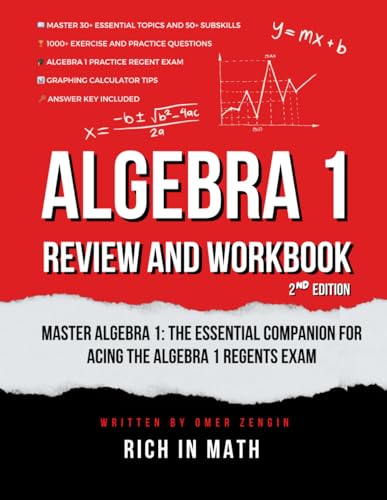
📘 Algebra 1 Regents Exam Prep Workbook (2nd Edition) — I built this workbook around exactly the question patterns described in this post, with practice sets organized by topic so students can drill the highest-value skills first. Available on Amazon.
🖼️ 30 Algebra 1 Digital Posters for Your Classroom — Keep the key formulas, vocabulary, and concepts in front of your students all year long with this printable poster set.
If you click the links below and make a purchase, we earn a commission at no additional cost to you.