If you have ever spent twenty minutes formatting a worksheet so the exponents actually look like exponents — raised, the right size, not just a caret symbol — you know exactly what problem this tool solves. The Properties of Exponents Worksheet Generator builds print-ready algebra worksheets in under two minutes, with every exponent, fraction, and coefficient rendered the way it should look on a professional math worksheet.
Exponents Properties Generator
Design · Customize · Download
Ten Exponent Rules, Three Difficulty Levels
The generator covers every standard rule your students need to master, organized so you can build a focused single-rule drill or a comprehensive mixed-review worksheet in the same sitting.
Basic rules are the right starting point for any introduction to exponent properties. The Product Rule generates problems like x³ · x² = x⁵, where students practice adding exponents with the same base. The Quotient Rule works the same logic in reverse — x⁵ / x² = x³ — and always generates problems where the numerator exponent is larger than the denominator, so the result stays positive and clean. Power of a Power produces problems like (x²)³ = x⁶, which forces students to multiply exponents rather than add them. Zero Exponent rounds out the basic set — (3x²)⁰ = 1 — and includes both variable and numeric base forms so students generalize the rule rather than just memorizing one case.
Medium rules require an extra conceptual step. Power of a Product generates problems like (2x)³ = 8x³, where students must distribute the exponent to both the coefficient and the variable — a reliable source of errors when students forget to raise the coefficient. Power of a Quotient applies the same distribution to a fraction, producing proper stacked-fraction answers like x²/4. Negative Exponent problems ask students to rewrite x⁻³ as 1/x³, and the generator mixes variable and numeric bases so the rule gets applied in both contexts.
Advanced rules push students to combine multiple properties. Negative Exponent (Quotient) generates expressions like x⁻²/x⁻⁵, where students need to apply the quotient rule while managing negative exponents. Mixed Variables (Product) generates two-variable products like 2x²y · 3xy² = 6x³y³ — the kind of problem that shows up on assessments and that students consistently rush through without accounting for every variable. Mixed Variables (Quotient) is the most demanding type, combining coefficient simplification with exponent subtraction across two variables.
The Details That Make It Actually Usable
Exponents render correctly. Every exponent is raised and sized the way it appears in a textbook — not as x^3 or x**3. In the preview, HTML superscripts handle the display. In the downloaded PDF, the exponents are drawn natively using jsPDF's drawing commands, positioning smaller text above the baseline. No workaround notation anywhere.
Fractions are stacked, not slashed. Every fraction — whether it is a quotient rule problem, a power of a quotient answer, or a negative exponent result — renders as a proper stacked fraction with a vinculum line. The numerator and denominator are centered and sized correctly in both the preview and the PDF.
Coefficients of 1 are never shown. The generator follows standard mathematical convention throughout — x⁵ never appears as 1x⁵, and a coefficient of -1 displays as just the negative sign, not -1x. Same rule applies to the answer key.
Answer key on a separate page. When you select Yes for the answer key, answers appear at the end of the PDF on their own page — not underneath each question. Download once, print the last page for yourself, keep the rest for your students.
Building Your Worksheet
Set your title, font, and variable in Panel 1. The variable selector lets you switch from x to y, a, n, or m — a simple way to keep students from pattern-matching answers based on variable rather than actually applying the rule.
In Panel 2, check the rule types you want. The difficulty badges — Basic, Medium, Advanced — tell you exactly what each type demands. For an introductory lesson, checking only Basic gives you a clean focused set. For a test-prep review, Select All gives you a comprehensive mixed worksheet in one click.
Panel 3 controls how many questions, how many columns, and how much row spacing. The Min Exponent and Max Exponent fields let you keep numbers manageable early in the unit — exponents of 2 through 4 are enough when students are first learning the rules. The Max Coefficient field controls how large the numeric coefficients get in product and quotient problems.
Panel 4 handles orientation, font size, and workspace. Portrait with Size 13 and no workspace fits a lot of questions on one page. Landscape with Size 15 and a large workspace gives students room to show every step, which is what you want for a graded assignment.
These worksheets are free to use, print, and distribute for educational purposes. However, this tool and its generated materials may not be used for commercial purposes.
More Free Algebra Tools
- Multi-Step Equations Worksheet Generator — 10 types across three difficulty levels with optional badges
- Two-Step Equations Worksheet Generator — stacked fractions, 12 question types
- Adding Polynomials Worksheet Generator — cubic terms, coefficient distribution, three-polynomial sums
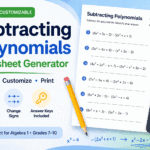
- Subtracting Polynomials Worksheet Generator — includes passive-language question types
All free. No account. Built for real classrooms.



If you click the links below and make a purchase, we earn a commission at no additional cost to you.