Are you looking for a playful, engaging way to help your youngest students build confidence with basic addition facts? Inspired by our “One Step Equation” smartboard challenge, this Addition Challenge version is designed specifically for kindergarteners, first graders, and second graders. It turns simple one-digit addition into a team-based game — combining collaboration, speed, and fun. As a teacher or parent, you can run this with your class to encourage cooperation, reinforce addition skills, and make math feel like a game.
How to Play: Setup & Rules
✅ Setup
- Project the Addition Challenge activity on your smartboard or interactive whiteboard.
- At the start, choose a “Challenge Title” (for example, “First Grade Addition Face-Off”).
- Ask students to form two teams (for example: “Red Team” and “Blue Team”).
- Give each team a name (e.g., “Number Ninjas,” “Math Rockets”).
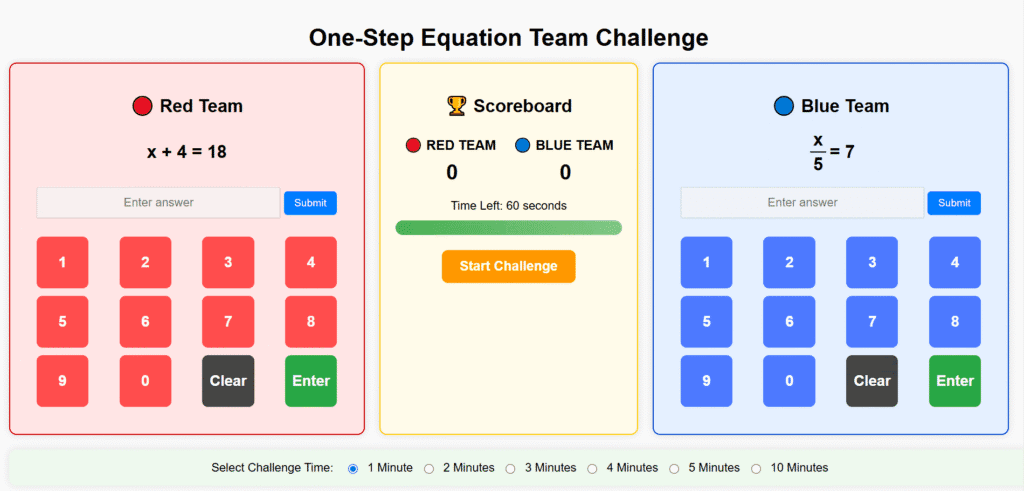
- Choose a time limit for the round — options like 1, 2, 3, 4, 5, or even 10 minutes (depending on how long you want the game to run and the kids’ attention spans).
👥 Team Structure
You can vary how students compete depending on class size:
- For very short games (e.g. 1 minute), you might let individual students play alone.
- For longer games, break the class into small groups so multiple students on a team get a turn.
- Before starting, let teams quickly plan the order of who goes first, second, etc. — this builds engagement and gives a sense of ownership.
🧮 Gameplay Mechanics
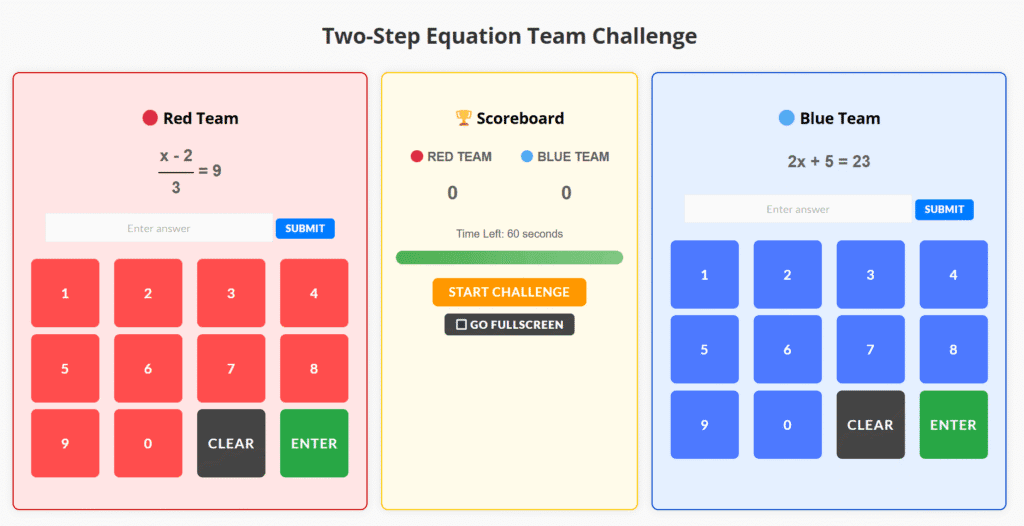
- When the teacher clicks “Start Challenge”, the timer begins (depending on the time chosen).
- Each player — one student at a time — attempts to solve as many one-digit addition problems (e.g., 4 + 7, 2 + 5) as possible during their turn.
- After a student’s turn ends (when the time for that turn is up), the next teammate takes over immediately.
- Teams can quietly discuss strategy between turns (e.g., “Let’s have our fastest adders go first”), but while a student is playing only they should be answering.
⚡ Setup Your Challenge
🏆 Scoring & Winning
- Each correct answer earns 1 point for that team.
- At the end of the time limit, total the points — the team with the highest score wins.
- Optional: you may run a sudden-death round (30 seconds) if there’s a tie, or declare a shared victory.
⚠️ Optional “Penalty Points” Mode (for older or more advanced 2nd graders)
- Turn on “Penalty Points.”
- Every time a team answers incorrectly, the opposing team earns 1 point.
- This encourages accuracy, not just speed — excellent for slightly older or more confident students.
📚 Why This Works for Young Learners
- Simple and accessible: Since problems are one-digit addition, even kindergartners or early first graders can participate with minimal guidance.
- Collaborative: Working in teams builds social skills — they cheer for each other, help each other, and take shared ownership of the outcome.
- Motivating: The game-like format makes practicing addition fun, and the time pressure adds excitement.
- Flexible: As teacher, you control how long the game runs, how teams are formed, and whether you include penalty points — so you can tailor the challenge to your class’s level and mood.
💡 Tips for Teachers & Parents
- Before playing, model a few example problems to make sure students are comfortable with the format.
- For younger learners, consider allowing verbal counting or finger-counting during their turn.
- Encourage team spirit and positive reinforcement — praise effort, speed and accuracy.
- To deepen learning, after the game revisit some of the problems and talk about number bonds (e.g. “What other ways could we make 9?”).
- Use small rewards — stickers, certificates, or even leading the next round — to build excitement and buy-in.
The Addition Challenge offers a simple yet powerful tool to build foundational addition skills in your youngest students while nurturing teamwork and engagement. It’s perfect for kindergarten through 2nd grade, but adaptable enough to fit different classes and levels. Try it in your next math block — you might be surprised at how much your students enjoy math when it feels like play.