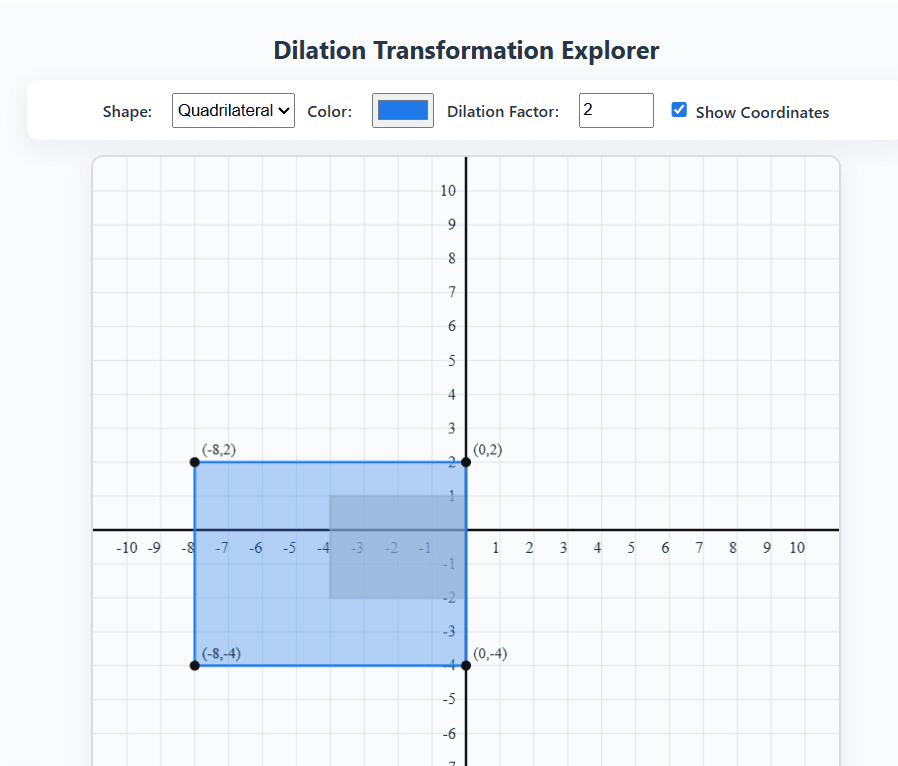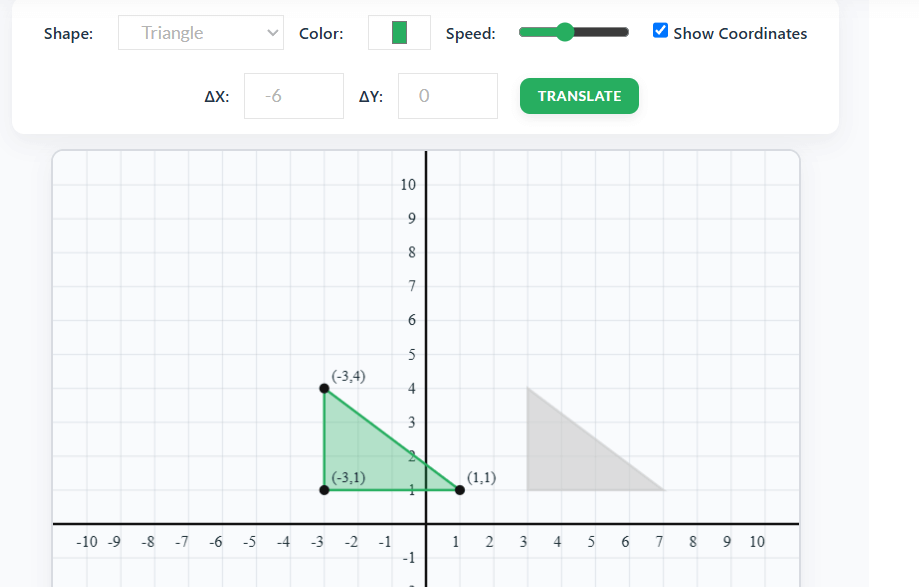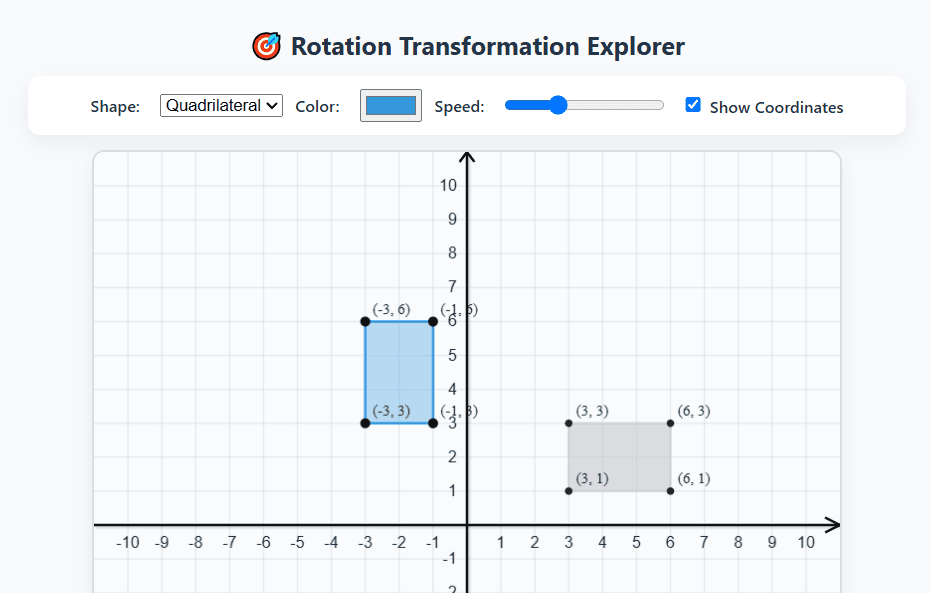
Let’s Make Reflections Come to Life!
Understanding reflections in geometry doesn’t have to mean memorizing rules from a textbook. Instead, let’s see and play with them!
In this interactive Reflection Activity, students can explore how shapes like triangles, quadrilaterals, and even circles move when reflected across different lines on the coordinate plane. It’s a perfect opportunity to turn abstract transformation rules into something visual, intuitive, and fun!
What You’ll Find in This Activity
Students and teachers can experiment with reflections on a coordinate grid ranging from -10 to 10 on both axes. The shapes can be reflected over:
- The x-axis
- The y-axis
- The origin
- The line y = x
- The line y = -x
Each time a reflection is applied, the shape moves to its mirrored position — and students can instantly see how the coordinates change. It’s a great way to connect geometric transformations to coordinate rules like:
- Reflect over the x-axis → (x,y)(x, y)(x,y) becomes (x,−y)(x, -y)(x,−y)
- Reflect over the y-axis → (x,y)(x, y)(x,y) becomes (−x,y)(-x, y)(−x,y)
- Reflect over the origin → (x,y)(x, y)(x,y) becomes (−x,−y)(-x, -y)(−x,−y)
- Reflect over y = x → (x,y)(x, y)(x,y) becomes (y,x)(y, x)(y,x)
- Reflect over y = -x → (x,y)(x, y)(x,y) becomes (−y,−x)(-y, -x)(−y,−x)
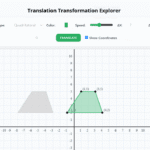
Reflection Transformation Explorer
Why Teachers Love This Activity
This activity isn’t just about getting the right answer — it’s about seeing the math happen.
Students can move shapes, try different reflection lines, and instantly understand why the coordinates change the way they do.
It’s perfect for:
✅ Smartboard lessons – Engage the whole class visually
✅ Small-group exploration – Let students test ideas and share discoveries
✅ Independent practice – Students can learn by experimenting at their own pace
Instead of memorizing rules, students build understanding through interaction and observation.
Try It Out and Reflect on Your Learning
Head to the activity below and have fun reflecting shapes! Encourage students to predict where the image will appear before applying the reflection — then check their thinking.
You can use this for warm-ups, review sessions, or even digital homework.