
Dilation Transformation in 8th Grade Math
In the study of transformations, dilation is an essential concept that helps students understand how shapes change size while maintaining their overall structure. Unlike rotations, reflections, or translations, dilation focuses on scaling shapes larger or smaller from a fixed point, often the origin, using a dilation factor.
Rules of Dilation
- Center of Dilation: The fixed point from which the shape expands or contracts. In most classroom activities, we use the origin (0,0) as the center.
- Dilation Factor (k):
- If k > 1, the shape enlarges.
- If 0 < k < 1, the shape reduces.
- If k = 1, the shape remains the same size.
- Coordinates: Each point of the shape is multiplied by the dilation factor:
$$ {\huge (x, y) \rightarrow (k \cdot x, k \cdot y)} $$
Activity: Dilation Transformation Explorer
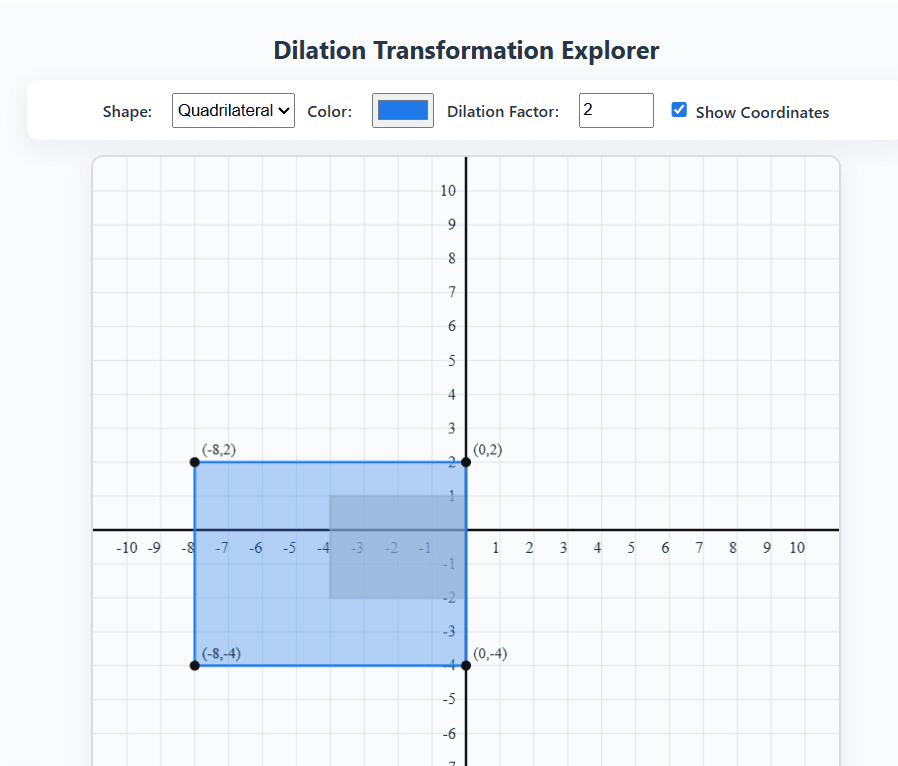
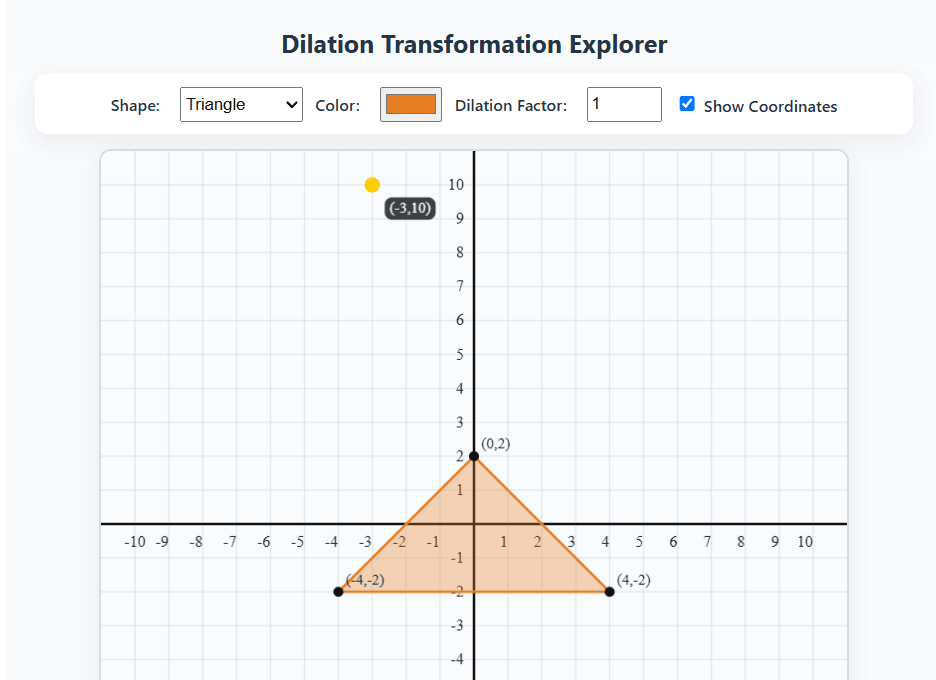
To help students explore dilation interactively, we created the Dilation Transformation Explorer. This activity allows students to:
- Select a shape: triangle, quadrilateral, or circle.
- Choose the color of the shape to visualize transformations clearly.
- Enter a dilation factor to scale the shape.
- Click Dilate to see the shape enlarge or shrink on a coordinate grid.
- Optionally, view the coordinates of each point for precise learning.
This hands-on experience helps students visualize how dilation works, strengthen their understanding of coordinate geometry, and connect abstract math rules with tangible transformations.
Dilation Transformation Explorer
How to Use This Activity in Class
- Start with a shape: Ask students to plot the vertices of a triangle, quadrilateral, or the center and radius of a circle.
- Pick a dilation factor: Students can test factors greater than 1 to enlarge or between 0 and 1 to reduce the shape.
- Observe the change: Students will see the new scaled shape while comparing it with the original. Discuss how the distance from the origin changes proportionally.
- Analyze coordinates: Encourage students to calculate the new coordinates manually and compare them with the interactive results to reinforce learning.
Why This Activity Matters
- Engages students: Interactive tools make abstract concepts concrete.
- Builds conceptual understanding: Students see the connection between math rules and visual outcomes.
- Supports differentiated learning: Students can experiment at their own pace, which helps both struggling and advanced learners.
- Prepares for real-world applications: Scaling and proportional reasoning are foundational skills in geometry, design, and engineering.
Try the Dilation Transformation Explorer now and help your students master this key transformation concept in a fun and engaging way!