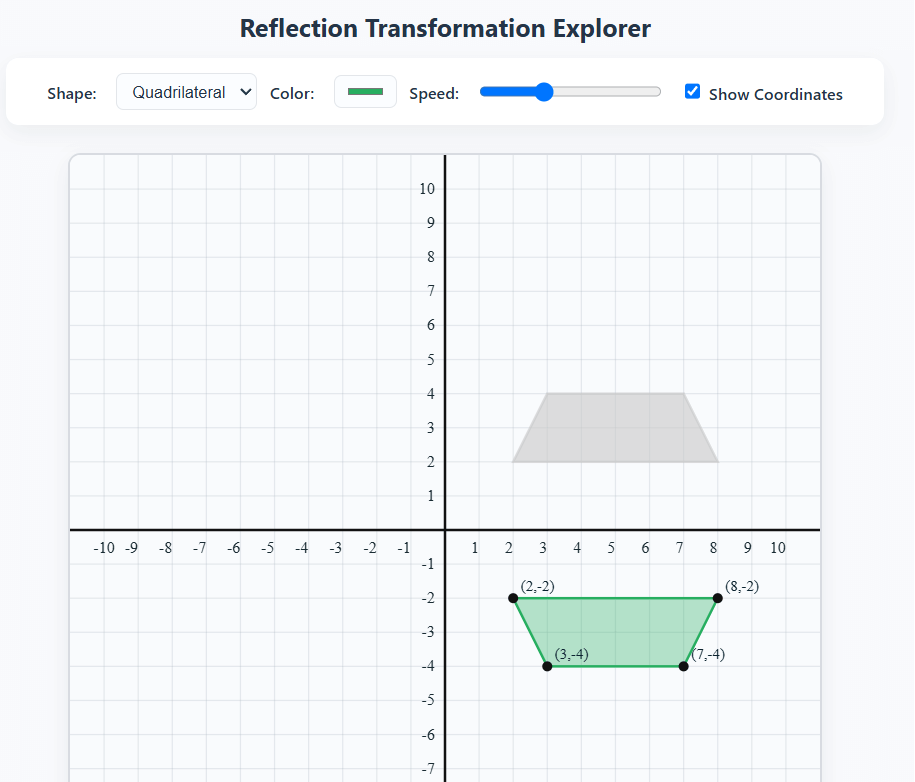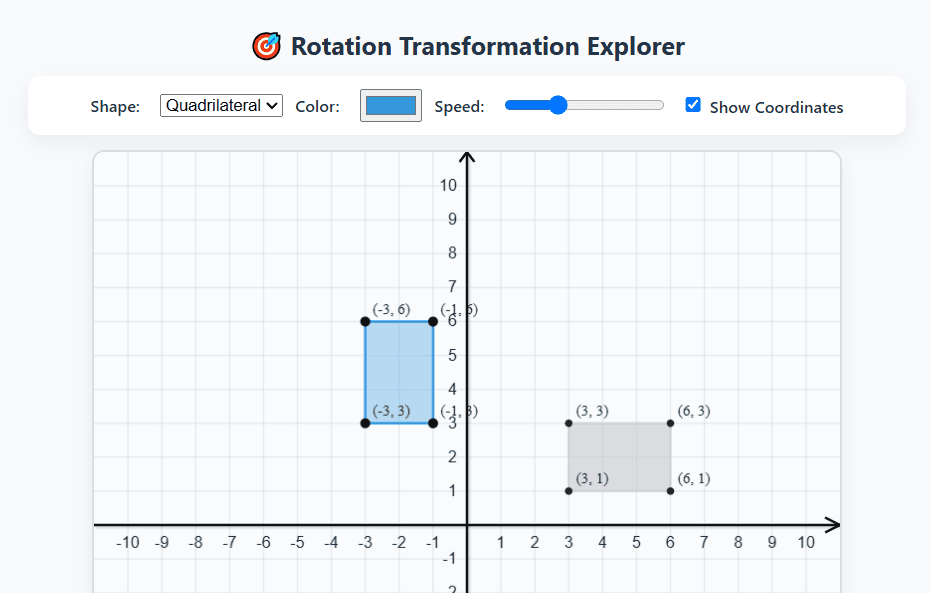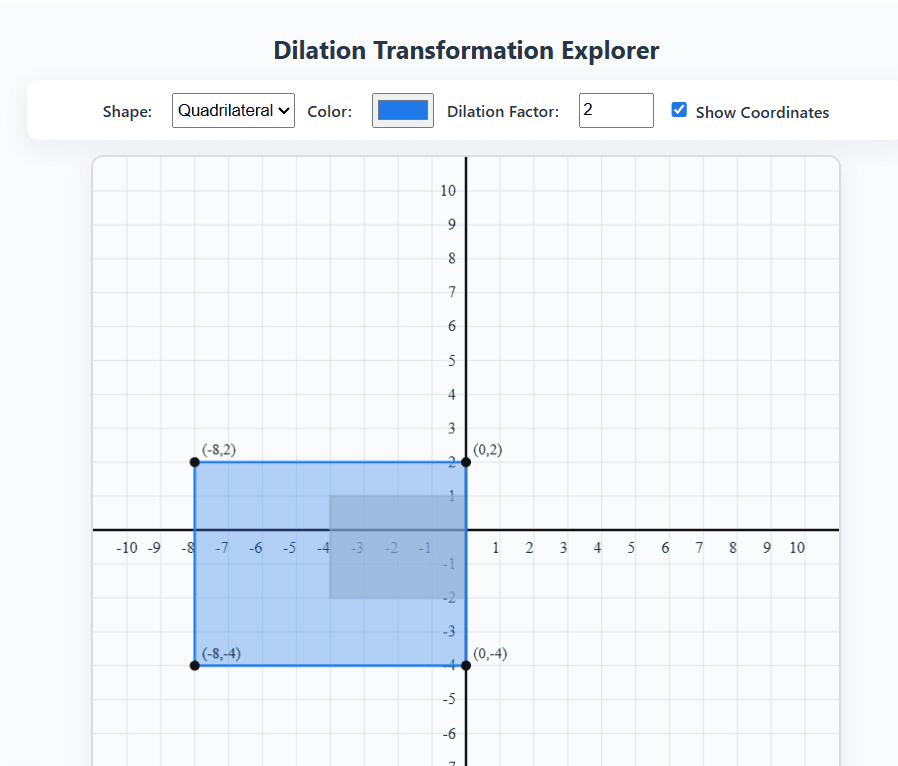
As math teachers, we know that transformations can sometimes feel abstract to students, especially when we talk about translations. Translation is simply sliding a shape on a coordinate plane without turning or flipping it. The good news is, students can see it, move it, and understand it with this interactive activity I created.
In this activity, students can translate triangles, quadrilaterals, and circles across a coordinate plane by setting values for ΔX and ΔY. It’s simple, visual, and a great way to get students practicing coordinate skills while reinforcing the rules of translation.
How to Use the Activity in Class:
- Choose a Shape – Pick a triangle, quadrilateral, or circle to work with.
- Set ΔX and ΔY – These numbers determine how far and in which direction the shape will move. ΔX moves the shape horizontally (positive is right, negative is left) and ΔY moves it vertically (positive is up, negative is down).
- Adjust Speed – You can slow down or speed up the animation to help students observe the movement.
- Translate the Shape – Click the “Move” button to watch the shape slide across the plane.
- Check Coordinates – Turn on the “Show Coordinates” option to see how each vertex changes, reinforcing the math behind the movement.
- Reset Easily – Clear the plane to start fresh and experiment with new translations.
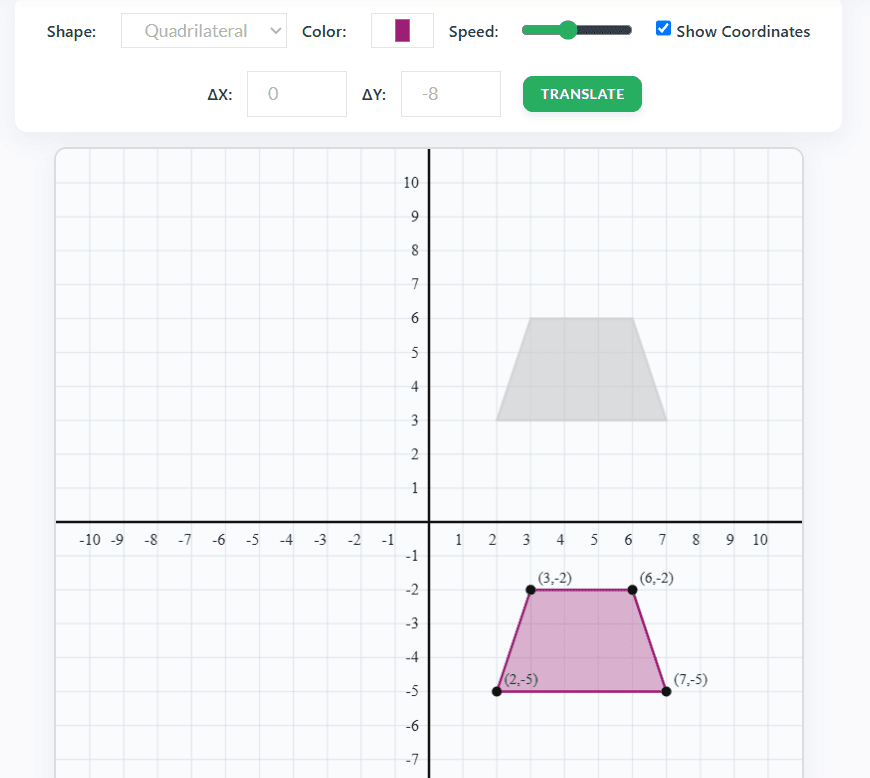
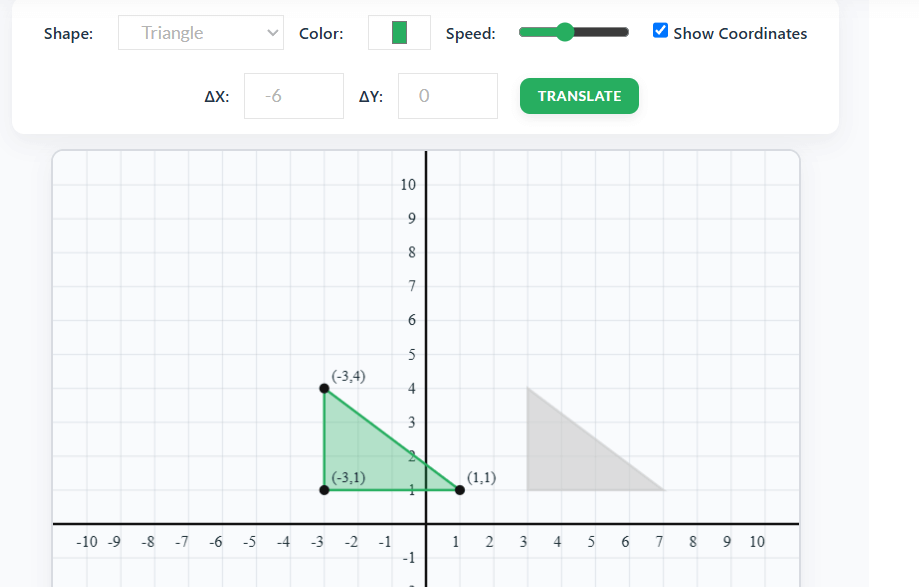
Translation Transformation Explorer
Key Translation Rules to Teach:
- Every point of the shape moves the same distance in the same direction.
- The shape does not rotate, flip, or change size.
- ΔX tells you how far to move horizontally: right (+), left (-).
- ΔY tells you how far to move vertically: up (+), down (-).
- Students can predict new coordinates for each vertex before performing the translation. This strengthens their understanding of the coordinate plane.
Classroom Tips:
- Start with small numbers for ΔX and ΔY so students can clearly see the movement.
- Have students write down the coordinates before and after the translation to connect visual and numerical understanding.
- Encourage experimentation: ask students to try negative values and combine horizontal and vertical moves.
- Turn it into a class challenge: one student sets a translation rule, and another predicts the new position.
Why This Activity Works:
- It turns an abstract concept into something tangible.
- Students actively practice moving shapes and predicting outcomes.
- Helps students gain confidence with coordinate plane skills.
- Makes learning interactive and engaging, not just a worksheet exercise.